
Our investment process follows a disciplined five-step approach that guides every deal from initial discovery through successful exit and investor distributions. This structured methodology ensures consistency, transparency, and optimal outcomes for our investment partners.
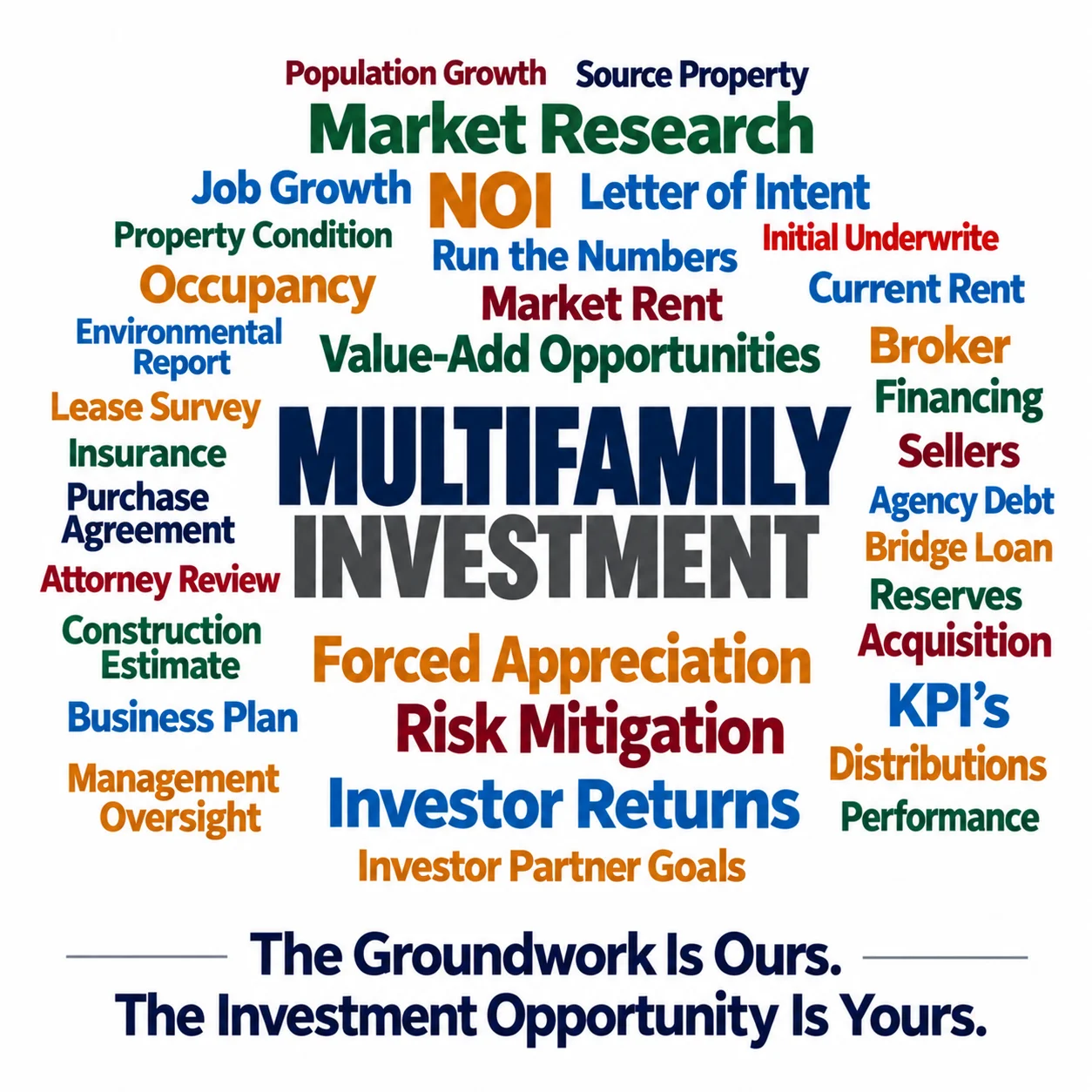
Using our relationships with both Brokers & Sellers, we identify potential multifamily opportunities and begin by examining the property and the market surrounding it. That includes population and job growth, neighborhood and market fundamentals, current versus market rents, property condition, operations, and where there may be an opportunity to create additional value.
Before pursuing a property, we run the numbers. We review provided annual income and expenses, rents, occupancy, financing, renovation needs, comparable properties, the assumptions and begin to formulate a potential business plan. We also consider the seller’s need to sell and their exit goals. If the initial research shows the deal may have legs, we dig deeper into the numbers. When the opportunity makes sense, we submit an LOI with appropriate buyer protections and due-diligence period. If further negotiation is necessary and completed, a date is set to execute the Purchase and Sale Agreement.
Once an offer is accepted, the Due Diligence continues. The property, financial records and assumptions are examined more closely. Our lender begins the work of securing financing for the property. Contractors, lenders, property-management professionals, attorneys and other specialists become involved. Information uncovered during due diligence is used to refine the underwriting and determine whether the investment still makes sense.

Using our relationships with both Brokers & Sellers, we identify potential multifamily opportunities and begin by examining the property and the market surrounding it. That includes population and job growth, neighborhood and market fundamentals, current versus market rents, property condition, operations, and where there may be an opportunity to create additional value.
Before pursuing a property, we run the numbers. We review provided annual income and expenses, rents, occupancy, financing, renovation needs, comparable properties, the assumptions and begin to formulate a potential business plan. We also consider the seller’s need to sell and their exit goals. If the initial research shows the deal may have legs, we dig deeper into the numbers. When the opportunity makes sense, we submit an LOI with appropriate buyer protections and due-diligence period. If further negotiation is necessary and completed, a date is set to execute the Purchase and Sale Agreement.
Once an offer is accepted, the Due Diligence continues. The property, financial records and assumptions are examined more closely. Our lender begins the work of securing financing for the property. Contractors, lenders, property-management professionals, attorneys and other specialists become involved. Information uncovered during due diligence is used to refine the underwriting and determine whether the investment still makes sense.
Once there is an executed purchase agreement and escrow has opened, prospective investors will enter the picture, are notified of the assembled investment opportunity and provided with an Investor Summary outlining the property, business plan, investment structure, projected financials, risks, and other key information.
At this stage, the investment structure and offering documents are also being developed by syndication specialist with the appropriate legal and securities compliances. Our lender begins the work of securing financing for the property. And we’re still not at the closing table. A dozen other details, approvals, clearances, and moving pieces still have to come together before the acquisition can close.
After closing, the business plan moves from paper to execution. Depending on the property, that can include light to medium renovations, operational improvements, management oversight, occupancy and rent strategies, expense controls and other value-add initiatives.
The work doesn’t stop after acquisition. Property performance, renovations, management, financial results and other key indicators are monitored, with ongoing reporting and communication to investors. Your planning document specifically identifies KPIs, renovation progress, management performance, distributions and material variances as part of that ongoing reporting.

Once there is an executed purchase agreement and escrow has opened, prospective investors will enter the picture, are notified of the assembled investment opportunity and provided with an Investor Summary outlining the property, business plan, investment structure, projected financials, risks, and other key information.
At this stage, the investment structure and offering documents are also being developed by syndication specialist with the appropriate legal and securities compliances. Our lender begins the work of securing financing for the property. And we’re still not at the closing table. A dozen other details, approvals, clearances, and moving pieces still have to come together before the acquisition can close.
After closing, the business plan moves from paper to execution. Depending on the property, that can include light to medium renovations, operational improvements, management oversight, occupancy and rent strategies, expense controls and other value-add initiatives.
The work doesn’t stop after acquisition. Property performance, renovations, management, financial results and other key indicators are monitored, with ongoing reporting and communication to investors. Your planning document specifically identifies KPIs, renovation progress, management performance, distributions and material variances as part of that ongoing reporting.
It begins with our team constantly monitoring multifamily markets across the United States for properties that meet our strict investment criteria. We evaluate location quality, building condition, and the gap between current performance and true market potential.
This involves physical inspections, financial analysis, market studies, and legal reviews to identify and mitigate potential risks. Only properties that pass this rigorous evaluation proceed to acquisition.
It focuses on strategic improvements that deliver the strongest return on investment. We upgrade unit interiors, improve common areas, and add amenities that justify higher rental rates.
It occurs once properties reach stabilized occupancy and rental income levels. We refinance into permanent long-term debt, paying off acquisition loans and returning initial capital to investors.
This ensures that properties continue to perform at optimal levels. We provide comprehensive updates every sixty days covering financial results, property operations, and progress against our business plan.