
Not every apartment building that comes across our desk deserves a closer look. We start with a specific set of criteria to help us determine whether the market, property, numbers and potential business plan warrant taking the next step.
Our investment criteria reflect the disciplined approach that has delivered consistent returns for our investors across multiple market cycles. We pursue properties that meet rigorous standards across several key dimensions to ensure quality and return potential.
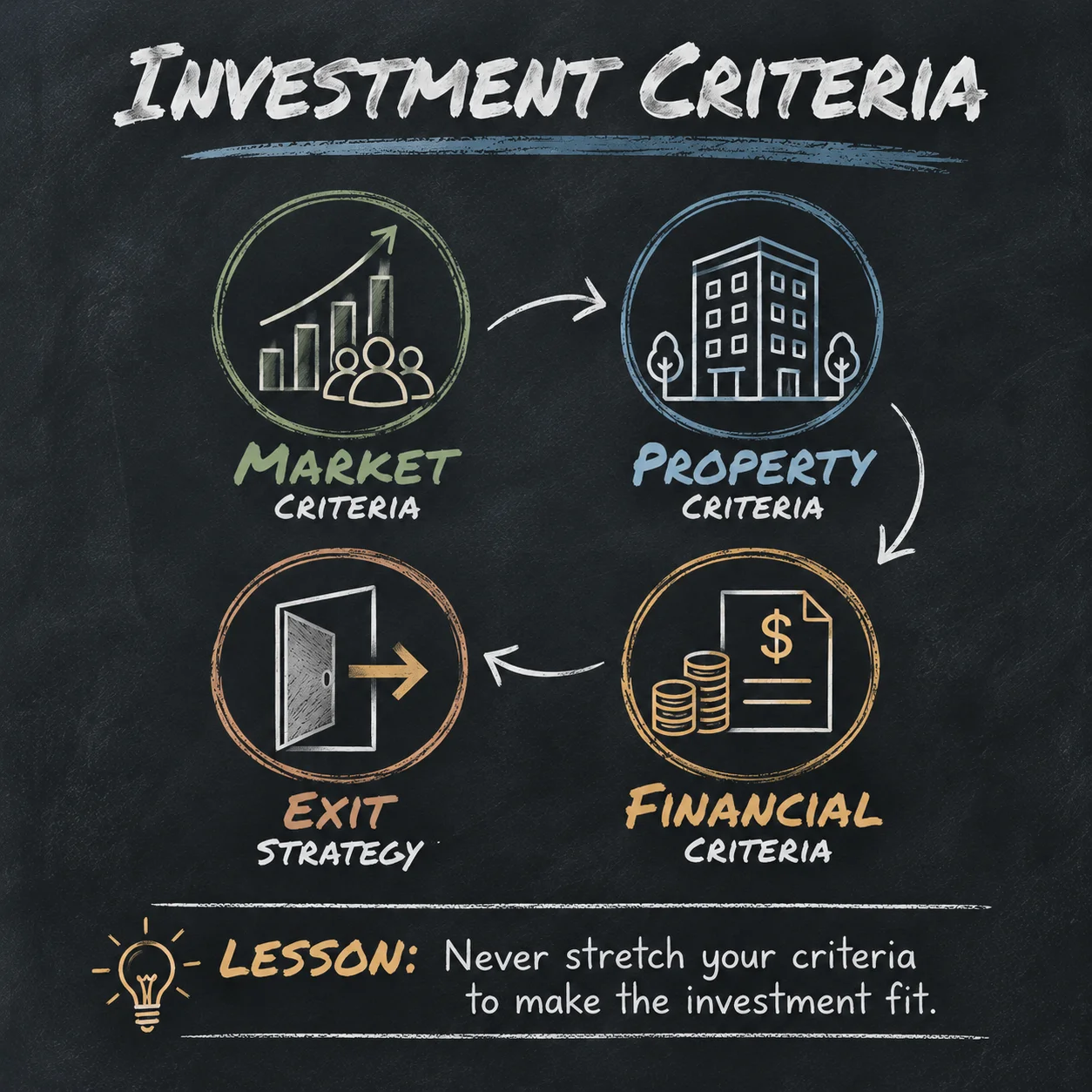
We look closely at population and job growth, rental demand, new construction and the diversity of the local employment base. The question isn’t simply whether people are moving to a market, it’s whether there are enough economic and housing fundamentals to support the property over the life of the investment.
We’re looking for more than an apartment building that’s simply for sale. We look for properties where we can identify opportunities to improve performance, such as below-market rents, deferred maintenance, outdated units, inefficient operations, occupancy issues, management opportunities or amenities that could be improved.
Those are some of the ingredients that may give a deal legs and warrant deeper underwriting
This is where we run the numbers. We examine the property’s current NOI using income and expenses, debt service, financing assumptions, renovation costs, reserves and the capital required to execute the business plan. We also test what happens when assumptions don’t go exactly as planned.
Potential returns get our attention. Whether those returns justify the risk is what matters. A deal shouldn’t depend on everything going right for the numbers to make sense.
We want to understand the possible exits before we ever buy the property. That means considering potential sale and refinancing scenarios, future market conditions, exit cap-rate assumptions, debt maturity and the likely buyer pool.
Since no one knows exactly what the market will look like several years from now, the exit strategy must be considered before we ever get to the closing table and not after.

We look closely at population and job growth, rental demand, new construction and the diversity of the local employment base. The question isn’t simply whether people are moving to a market, it’s whether there are enough economic and housing fundamentals to support the property over the life of the investment.
We’re looking for more than an apartment building that’s simply for sale. We look for properties where we can identify opportunities to improve performance, such as below-market rents, deferred maintenance, outdated units, inefficient operations, occupancy issues, management opportunities or amenities that could be improved.
Those are some of the ingredients that may give a deal legs and warrant deeper underwriting
This is where we run the numbers. We examine the property’s current NOI using income and expenses, debt service, financing assumptions, renovation costs, reserves and the capital required to execute the business plan. We also test what happens when assumptions don’t go exactly as planned.
Potential returns get our attention. Whether those returns justify the risk is what matters. A deal shouldn’t depend on everything going right for the numbers to make sense.
We want to understand the possible exits before we ever buy the property. That means considering potential sale and refinancing scenarios, future market conditions, exit cap-rate assumptions, debt maturity and the likely buyer pool.
Since no one knows exactly what the market will look like several years from now, the exit strategy must be considered before we ever get to the closing table and not after.

Every deal is peer-reviewed. Challenging a deal rather than looking for reasons to make it work is part of our underwriting culture. As part of that process, we participate in live review sessions where experienced multifamily operators take a fresh look at deals, challenge, ask questions or confirm the assumptions, pick apart the numbers, and search for holes, overlooked discrepancies, or risks that may have been missed. The sessions itself aren’t called “Kill the Deal,” but it effectively provides another set of experienced eyes looking for reasons the deal may not work. What happens if projected rents don’t materialize? Renovations cost more than expected? Occupancy drops? Financing terms change? Or the property takes longer to stabilize than planned?
If the review uncovers a problem, that doesn’t automatically end the deal. First, we determine what the issue means for the property, the NOI, and the business plan. New information may require changes to our assumptions, additional analysis or further negotiation with the seller.
But the objective isn’t to find a way to make the deal work. It’s to determine whether the deal still works within our investment criteria.
If it does, it may have earned the right to move another step forward. If solving the problem requires us to stretch our assumptions or move beyond the standards we established for the investment, that’s when walking away may be the right decision.